

askTheodor is live: your AI workforce, on your machine
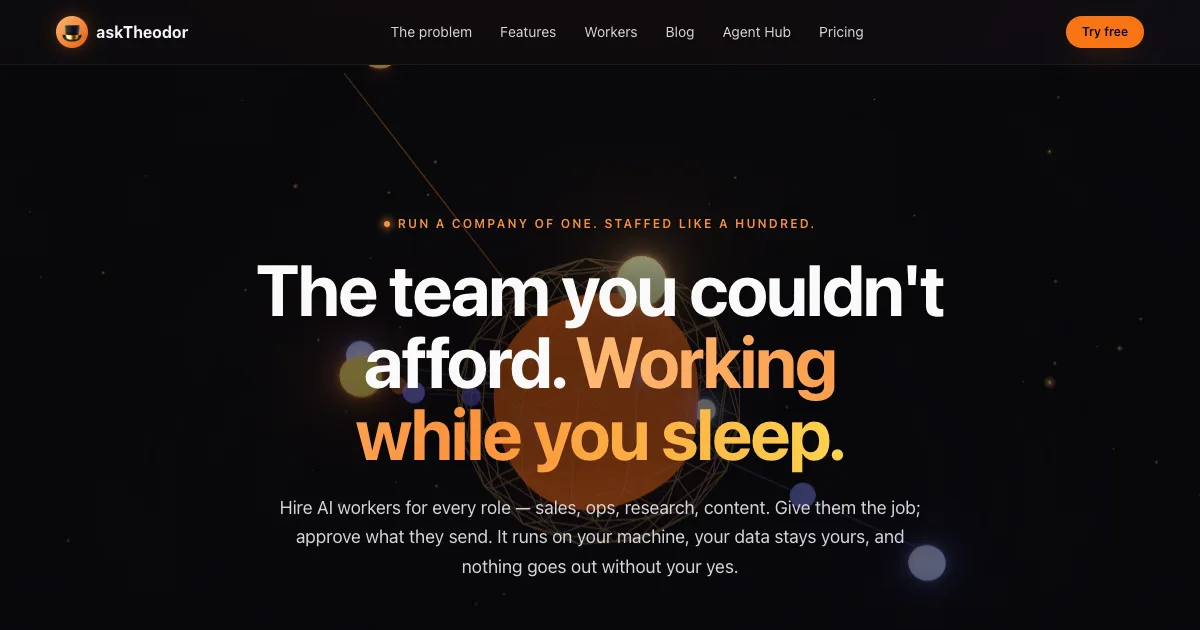
askTheodor is here — hire AI workers for sales, ops, research and content, hand them a task, and approve what they send. It runs on your machine, and nothing leaves without your yes.
On 17 July 2026 we launched askTheodor. The idea fits in one sentence: run a company of one, staffed like a hundred. You hire AI workers for sales, ops, research and content, hand them the job, and approve what they send back.
Why askTheodor exists
askTheodor grew out of our own day-to-day as a small agency. When you run a business alone or with one other person, you are sales, support, ops and the books at once. The work only you can do gets pushed to the evening.
The AI tools we had treated agents like chatbots: something you talk at, not colleagues you delegate to. What we needed was a team: someone to prepare the quotes, gather the research and keep operations moving, while the decisions stay with us.
Agents prepare, humans approve
That is the most important decision in askTheodor, and it isn’t negotiable. Nothing leaves the building without your explicit yes.
Every action lands in an approvals queue. There is a risk gate, a kill switch and a full audit log. That’s the difference between automation you babysit and a team you trust.
Your machine, your data
askTheodor is a desktop app for macOS and Windows, and it is local-first: prompts, files, search indexes and credentials stay on your machine. You bring your own keys for Anthropic, OpenAI or Gemini, chosen per worker, or run a local model through Ollama, fully offline if you like.
The tools are driven through the Model Context Protocol (MCP). That turns plain-language instructions into real, reviewable actions.
A team, organised like a real one
- Theodor, chief of staff: runs the workforce. He hires specialists from 95 professions, hands each task to the right one and reports back in plain numbers.
- Companies: group workers, files and conversations by client, project or area. Each company has its own Library and search index.
- Plans: big asks become tasks with dependencies. They run as soon as what they depend on is done, are retried on failure and are summarised at the end.
- Memory and Library: every worker remembers yesterday. Everything they produce is filed and searchable, and their answers cite their sources.
- Overnight work: routines keep going while you sleep. A morning digest tells you what shipped.
- Real ops work: workers can run a dev server, deploy over SSH, read spreadsheets and PDFs, and search a codebase.
- Your own fleet: set up specialised askTheodor instances on your own servers over SSH, running around the clock.
- Templates: 116 task templates, and playbooks all the way to launching a business.
Try it
askTheodor comes with a 7-day free trial, no card needed. After that it’s one flat licence instead of per-seat fees; you pay for the AI model directly to the provider you choose.
Visit askTheodor · Documentation · Academy
Want to know whether askTheodor fits the way you work, or connect it to your own tools? Talk to us.